Background
Interference caused by passive intermodulation (PIM) has become a serious problem for network operators around the world. As more and more frequency bands are deployed at cell sites, operators will eventually create a condition where 3rd order intermodulation products (IM3) fall in one or more of their uplink bands. These 3rd order intermodulation products are strong enough to "deafen" uplink receivers, significantly reducing network performance.
So, what can operators do to eliminate PIM interference? The first option is to "do nothing" and live with the reduced network performance. The second option is to turn off or significantly reduce the power of the offending frequency bands generating the IM3 interference. Neither the first or second option may be practical due to growing coverage and capacity requirements. The third option is to "wage war" on PIM and remove as many PIM sources as possible in the RF path.
When choosing the third option, be prepared for change. The entire site build process needs to be re-evaluated starting with site selection. Antenna placement guidelines will need to be revised, materials used to build cell sites will need to change and attention to detail during installation will need to improve. This will take a coordinated effort across the entire organization to make the required changes (site acquisition, RF design, site construction, RF optimization). The pay-off will be more efficient use of available spectrum resulting in improved network performance. Sites will also be able to be put on air more efficiently, reducing cost and reducing schedule over-runs.
This document is intended to help guide operators in their PIM mitigation journey. It breaks down PIM sources into two types, internal and external, and provides a list of controls that are needed to proactively prevent these sources from occurring in the field. Material separation guidelines are provided in wavelengths based on lab tests and on what has proven effective in the field. Operators are encouraged to translate these requirements into "feet" or "meters" in their construction standards based on the frequency bands deployed. (Operators deploying 600 MHz spectrum, for instance, may require different spacings than operators deploying 900 MHz as their lowest operating frequency band.)
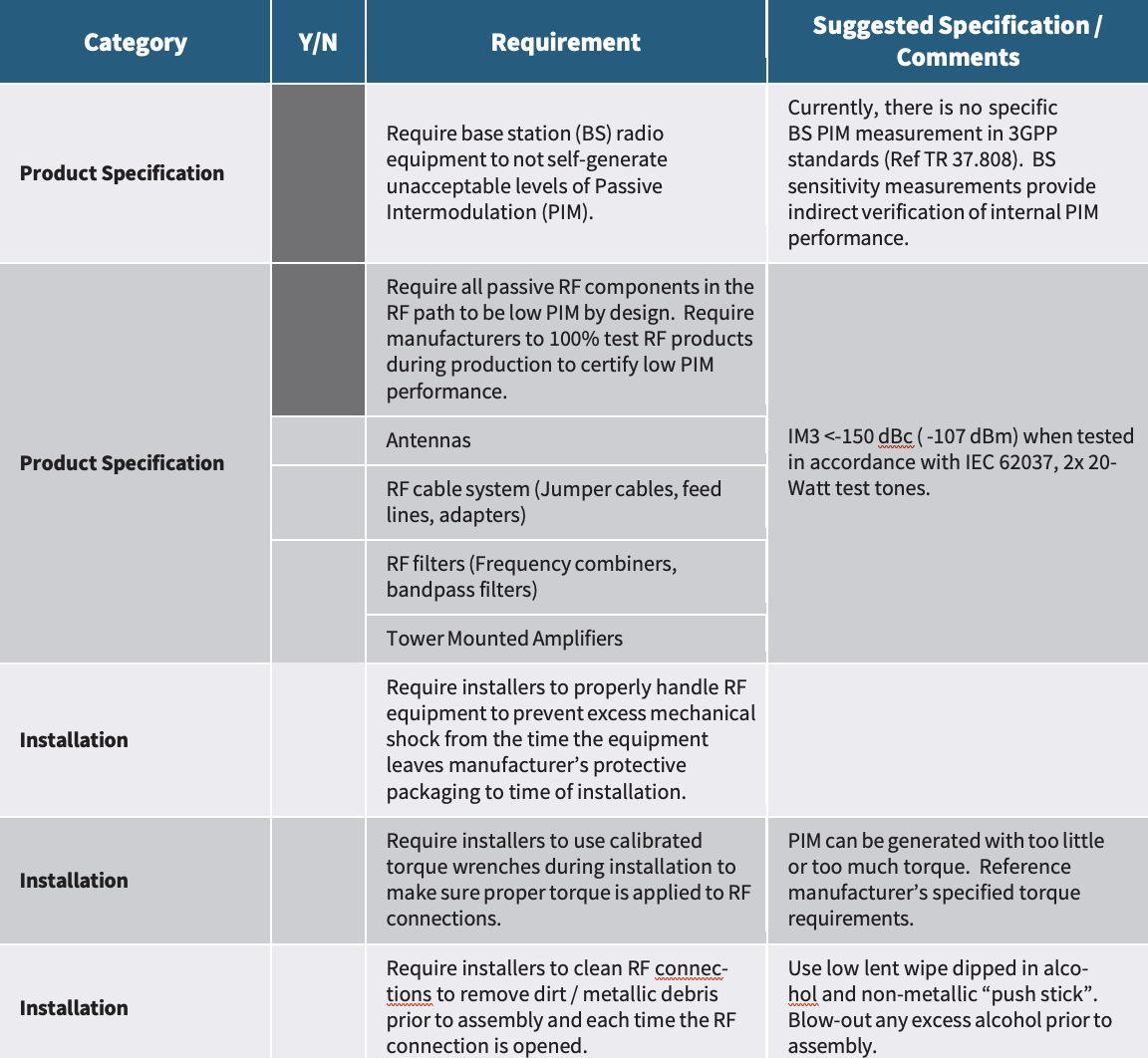
A "Y/N" column (Yes/No) is provided in each table that is intended to be used by operators for self-assessment. To truly be proactive in mitigating PIM interference, an action plan should be put in place to create guidelines / specifications to address all the "No's".
Internal PIM Mitigation Requirements
PIM sources inside the antenna feed system.
Internal PIM Mitigation Requirements
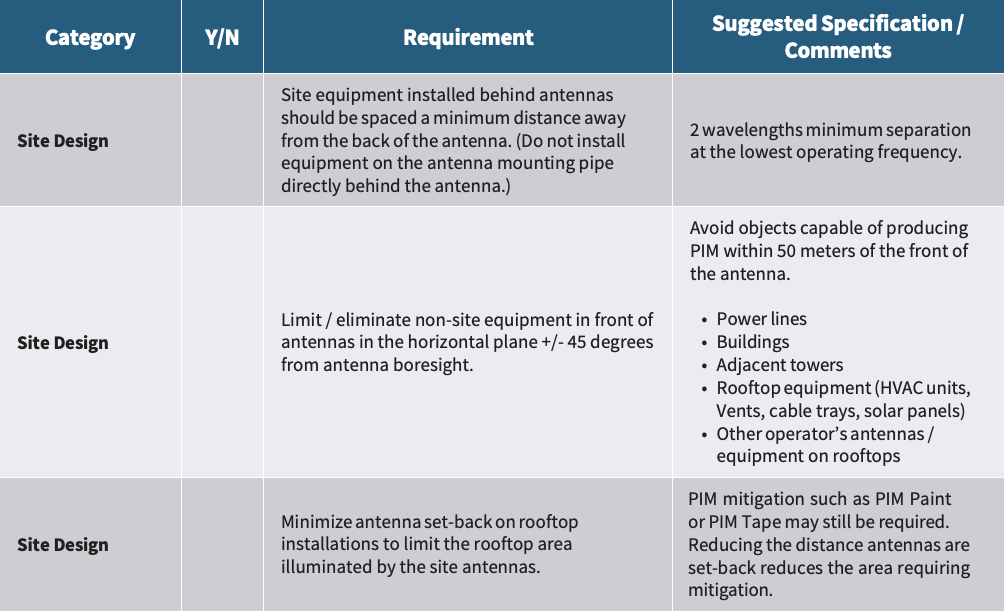
PIM sources beyond the antenna equipment.
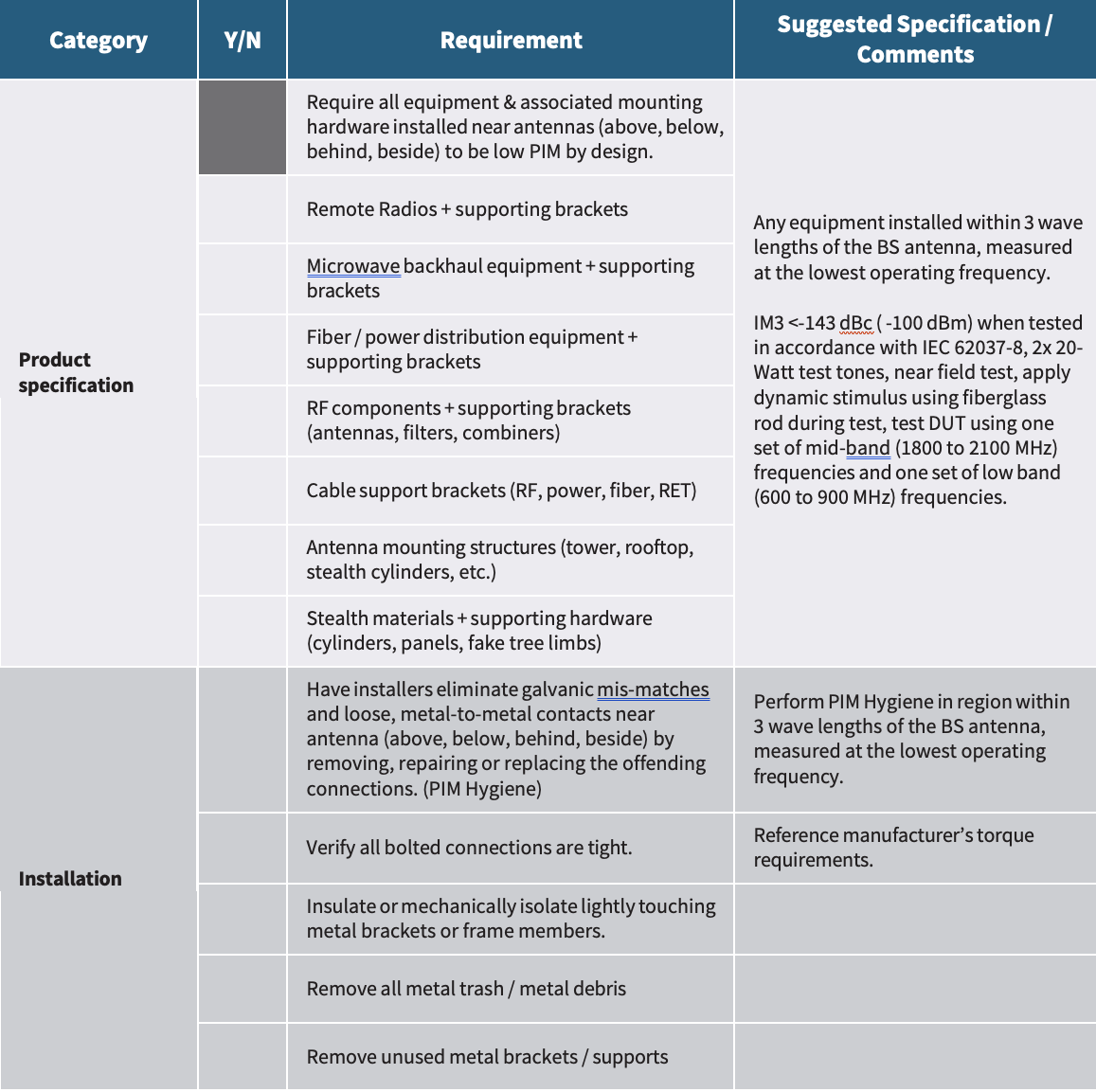
Internal PIM Mitigation Requirements
PIM sources beyond the antenna equipment.
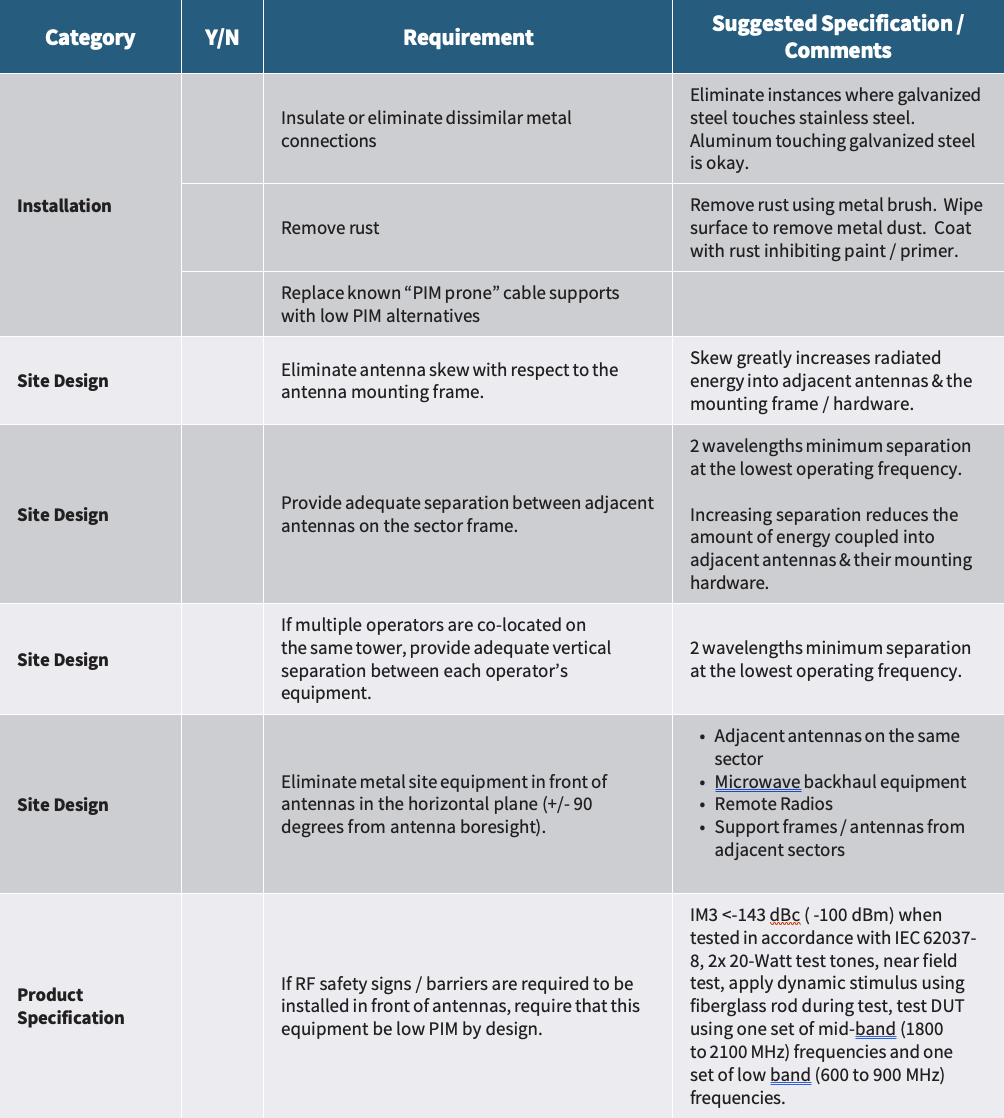
Internal PIM Mitigation Requirements
PIM sources beyond the antenna equipment.
NOTE
If non-site equipment / large antenna set-backs are unavoidable at candidate rooftop sites, an antenna of similar gain / beamwidth as the planned site antenna may be temporarily placed at the design location to evaluate PIM levels. During the evaluation, temporary mitigation (PIM blankets, PIM foil) can be deployed to identify the location and magnitude of external PIM sources requiring mitigation. "Distance-to-PIM" can be used to identify the location and magnitude of PIM sources off the sector (power lines, nearby buildings) that may not be able to be mitigated. Armed with this knowledge, operators can estimate PIM interference levels and decide whether or not to proceed with the candidate site / sector configuration.